


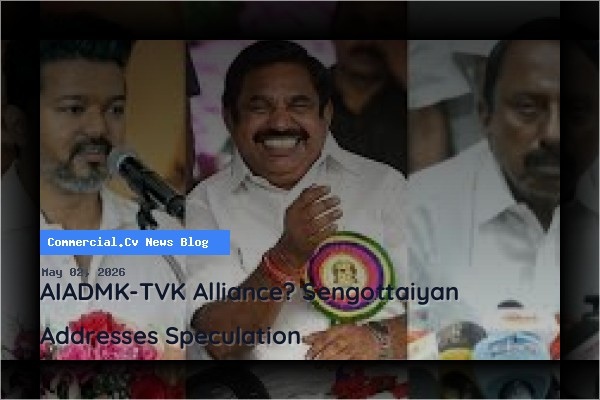
AIADMK Leader K.A. Sengottaiyan Responds to TVK Alliance Rumours
Chennai, Tamil Nadu – In the dynamic political landscape of Tamil Nadu, whispers of potential electoral alliances and shifts in party allegiances are a constant. Recently, senior leader of the All India Anna Dravida Munnetra Kazhagam (AIADMK), K.A. Sengottaiyan, addressed a pertinent question regarding a hypothetical scenario involving the Tamilaga Vettri Kazhagam (TVK), led by actor-turned-politician Thalapathy Vijay. When questioned about the possibility of the AIADMK aligning with the TVK should the latter fail to secure a majority in future elections, Sengottaiyan offered a measured response, leaving the door open to speculation while refraining from definitive pronouncements.
Background: The Emergence of TVK and Political Realignment
The formation of the Tamilaga Vettri Kazhagam (TVK) by Thalapathy Vijay earlier this year marked a significant development in Tamil Nadu politics. With a substantial fan base and considerable influence, Vijay's entry into the political arena has been closely watched. Political analysts have been dissecting the potential impact of TVK on the existing Dravidian political strongholds of the AIADMK and the Dravida Munnetra Kazhagam (DMK). The party has declared its intention to contest the upcoming Lok Sabha elections and subsequently the Tamil Nadu Assembly elections in 2026. This has naturally led to discussions about its electoral strategy and potential alliances, especially with parties that might find common ground or strategic advantage in partnering with a new, influential force.
The AIADMK, a veteran in Tamil Nadu politics, is currently navigating its own internal dynamics and electoral challenges. Having been a dominant force for decades, the party is keen on regaining its electoral footing. In this context, any new significant political entity like the TVK inevitably becomes a subject of strategic consideration for established parties. The question posed to Sengottaiyan reflects this broader political calculus, examining how established players might react to the emergence of new contenders and their potential electoral performance.
Key Developments: Sengottaiyan's Statement on Potential Alliance
During a recent press interaction, K.A. Sengottaiyan, a prominent figure within the AIADMK's leadership, was directly asked about the party's stance on a potential alliance with the TVK. Specifically, the question revolved around whether the AIADMK would consider joining forces with the TVK if the latter, despite its aspirations, were to fall short of achieving a majority in an election. Sengottaiyan's response was nuanced. He acknowledged that such decisions are typically made based on the prevailing political circumstances and the broader interests of the party and the state.
While not explicitly confirming or denying a future alliance, Sengottaiyan stated that the AIADMK would analyze the situation if and when it arises. He indicated that the party leadership would deliberate on the matter, taking into account the political climate and strategic advantages. This approach is typical in Indian politics, where alliances are often fluid and contingent on electoral outcomes and the perceived benefit to the participating parties. His statement can be interpreted as a pragmatic acknowledgement of the evolving political landscape, where new alliances are not entirely out of the question, but are subject to careful evaluation.
“The political situation will be assessed at the appropriate time. Decisions will be made based on the prevailing circumstances,” Sengottaiyan reportedly commented, as per reports from Oneindia Tamil. This statement, while vague, suggests that the AIADMK is not rigidly closing its doors to future political collaborations, but is also not actively pursuing one at this moment. The emphasis on "prevailing circumstances" highlights the adaptive nature of political strategies in India.
Impact and Analysis: Navigating the Electoral Chessboard
The AIADMK's current position in Tamil Nadu politics necessitates a strategic approach to electoral alliances. The party has experienced a decline in its electoral fortunes in recent years, and forging effective partnerships could be crucial for its revival. The TVK, with its burgeoning influence, presents a potentially valuable ally, especially if it manages to carve out a significant vote share. However, any alliance would also involve careful consideration of the ideological compatibility and the potential dilution of each party's core identity.
Sengottaiyan's response suggests that the AIADMK is adopting a wait-and-watch approach. This is a prudent strategy, as prematurely committing to an alliance could alienate other potential partners or voters. By keeping the option open, the AIADMK signals its readiness to adapt to electoral dynamics. Furthermore, the response also subtly acknowledges the growing significance of the TVK as a political force, indicating that the AIADMK leadership is taking its potential impact seriously.
The analysis of such potential alliances often goes beyond mere vote consolidation. It involves understanding the demographic appeal of each party, their leadership strengths, and their ability to mobilize voters. The TVK's appeal, largely rooted in the charismatic persona of Thalapathy Vijay, could potentially attract younger voters and those disillusioned with the traditional Dravidian parties. If the TVK performs well but falls short of a majority, the AIADMK might see an opportunity to absorb some of its momentum and voter base through an alliance, or conversely, to position itself as a natural successor to the vacuum left by any perceived underperformance of the DMK.
What's Next: Future Electoral Strategies and Political Dynamics
The immediate future will likely see both the AIADMK and the TVK focus on their respective electoral strategies for the upcoming Lok Sabha elections. The performance of the TVK in these elections will be a critical indicator of its electoral strength and its potential role in future state-level politics. For the AIADMK, the Lok Sabha elections will be an opportunity to assess its current standing and the effectiveness of its existing alliances, such as its partnership with the Bharatiya Janata Party (BJP) in the NDA coalition.
K.A. Sengottaiyan's measured response indicates that the AIADMK is prepared for strategic flexibility. The party leadership will undoubtedly be closely monitoring the electoral performance of all major political players, including the TVK. Should the TVK emerge as a significant force that falls just short of a majority, the scenario painted by the question to Sengottaiyan could indeed become a reality. In such a situation, the AIADMK's decision-making process will be guided by its overarching goal of regaining political power in Tamil Nadu, weighing the benefits and drawbacks of aligning with a new, influential political entity.
The political chessboard of Tamil Nadu remains intricate, with new players and evolving strategies constantly reshaping the landscape. The cautious yet open approach adopted by senior AIADMK leaders like Sengottaiyan suggests a pragmatic understanding of these dynamics, preparing the party for various eventualities in the complex electoral battles ahead.
Source: Oneindia Tamil



Share on