


The article outlines a world on April 12, 2026, that has transitioned from digital transformation to an era of autonomous integration. The "novelty" of AI has been replaced by a pragmatic, if cautious, reliance on agent-based systems, while the global landscape grapples with the physical realities of climate adaptation and a multi-polar political order.
1. The Technological Landscape: The AI Inflection Point
By April 2026, the world will have moved past the "novelty" phase of Generative AI and deep into the Autonomous Agent era.
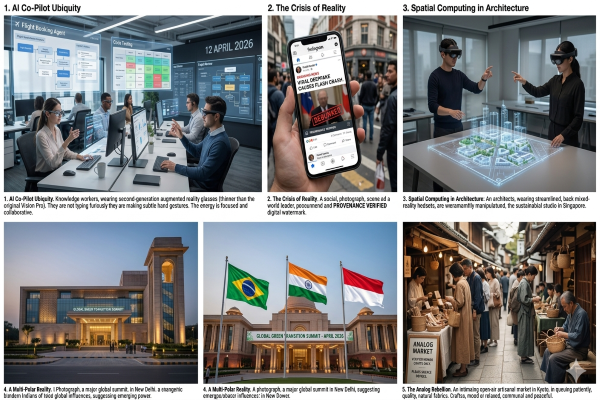
- The AI Co-Pilot is Ubiquitous: On this day, the majority of knowledge workers won't just use AI to draft emails; they will manage "agents" that execute multi-step tasks (booking flights, analyzing legal contracts, writing and testing code).
- The Crisis of Reality: April 2026 will be navigating the deep fallout of hyper-realistic deepfakes. On any given day, a viral video of a world leader declaring war or a CEO confessing to fraud will circulate, causing momentary market crashes before being debunked. "Zero-trust media" is the default. Digital watermarking and provenance technology are booming industries.
- Spatial Computing: Apple Vision Pro and its competitors are in their 2nd generation, lighter and cheaper. On April 12, 2026, a significant portion of the global workforce in design, engineering, and architecture will be working in mixed reality, and "flat screens" will feel increasingly dated.
2. Geopolitics: A Multi-Polar Reality
The global order will be firmly multi-polar, defined by strategic regional blocs rather than a single superpower dictate.
- The US and China: The "Cold Tech War" is at a steady simmer. The world is broadly divided into Western-aligned tech ecosystems and Chinese-aligned ones. Taiwan remains the ultimate flashpoint; April 2026 sees routine military posturing, but the mutual dependency on global trade keeps the peace fragile but intact.
- The Global South Flexes: Brazil, India, and Indonesia are the diplomatic power brokers. On this day, there is likely a major global summit taking place where the "Green Transition" is being negotiated. The Global South is refusing to transition away from fossil fuels without massive, no-strings-attached financial compensation from the West.
- Europe’s New Normal: Europe has fully adapted to a post-Russian-energy landscape, relying heavily on renewable grids, nuclear revivals, and LNG imports. However, internal political fracturing over immigration and the cost of living remains a persistent headache.
3. The Climate and Environment: The Era of Adaptation
By spring 2026, "climate change" is no longer a future threat; it is the present baseline. The conversation has permanently shifted from prevention to adaptation and resilience.
- The Weather on April 12: In the Northern Hemisphere, early spring heatwaves are the new normal. Extreme weather events are so frequent that they no longer dominate the news cycle unless they are catastrophic.
- Climate Reparations: The "Loss and Damage" fund agreed upon at previous COP summits is finally operational, but the debate on this day is likely about the inequity of the payouts and the slow bureaucratic process of getting funds to sinking islands or drought-stricken nations in Africa.
- Geoengineering Debates: As carbon emissions remain stubbornly high, April 2026 will feature prominent, highly controversial think-pieces and policy debates about Solar Radiation Management (dimming the sun)—a concept moving from fringe science to urgent policy consideration.
4. Economy and Work: The "Hybrid-Permanent"
- The 4-Day Week: By 2026, the 4-day workweek is no longer an experiment; it is standard in much of Europe, parts of North America, and among global tech companies. April 12 is a Sunday, but the weekend "Friday-Sunday" feel is culturally entrenched in these regions.
- Greenflation: The cost of living remains high globally, but the drivers have shifted. It is no longer just supply chain kinks; it is "greenflation"—the massive capital required to build out EV grids, sustainable supply chains, and AI data centers is keeping interest rates and consumer prices elevated.
- Space Economy: April 12 is the UN's International Day of Human Space Flight. On this day in 2026, the global space economy is booming. NASA’s Artemis III mission (aimed at returning humans to the Moon) is in its final months of preparation, dominating the news cycle and sparking a new space race. Commercial space stations are under active construction.
5. Culture and Society: Fragmentation and Longing
- Hyper-Personalization: Entertainment is deeply individualized. On April 12, 2026, you won't just watch a movie; your AI will generate a movie tailored specifically to your mood, featuring AI-generated versions of your favorite actors, in real-time. Shared cultural moments (like a global hit TV show) are increasingly rare.
- The Analog Rebellion: As a reaction to the hyper-digital AI world, there is a premium placed on "verified human" and "analog" experiences. Live concerts, physical artisanal crafts, and in-person sports are more popular and expensive than ever. People pay a premium for "digital detox" weekends.
- Hyper-Personalization: Entertainment is deeply individualized. On April 12, 2026, you won't just watch a movie; your AI will generate a movie tailored specifically to your mood, featuring AI-generated versions of your favorite actors, in real-time. Shared cultural moments (like a global hit TV show) are increasingly rare.
- The Analog Rebellion: As a reaction to the hyper-digital AI world, there is a premium placed on "verified human" and "analog" experiences. Live concerts, physical artisanal crafts, and in-person sports are more popular and expensive than ever. People pay a premium for "digital detox" weekends.


Share on