


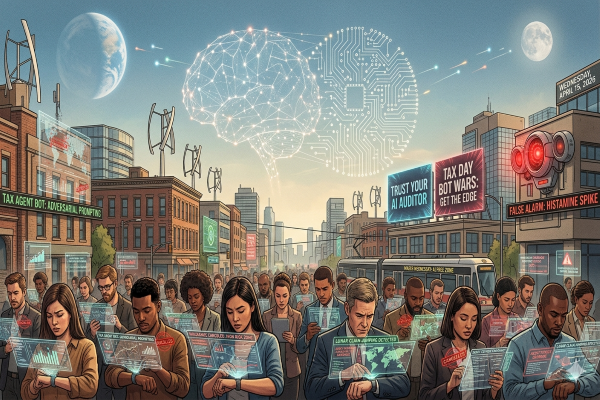
If April 12 was the weekend of rest, April 13 the Monday awakening, and April 14 the day of systemic friction, then April 15, 2026 (Wednesday), is the day of The Algorithmic Tug-of-War. It is the hump day of a 4-day workweek, where the immediate crises of the week have stabilized, but the deeper, structural battles of the future are fought in the background.
Here is a plausible projection of what the world will look like on 15/04/2026.
1. The Economic Anchor: "Tax Day" and the Bot Wars
In the United States, April 15 is traditionally Tax Day. In 2026, this mundane administrative deadline has become a massive digital battleground, the effects of which ripple through the global economy.
- The AI Optimization Arms Race: Nobody files their own taxes anymore. The week leading up to April 15 has been a silent war between millions of personal-finance AI agents trying to aggressively minimize their clients' tax liabilities, and government AI auditors trying to close loopholes in real-time.
- Algorithmic Deadlock: On April 15, the IRS servers are overwhelmed not by human error, but by "adversarial prompting"—AI agents submitting highly complex, legally gray claims at the very last minute. The government announces a 48-hour extension, blaming "bad-faith algorithmic flooding," sparking a fierce political debate over whether AI tax strategy should be classified as fraud or a standard fiduciary duty.
2. The Climate Reality: "Climate Redlining" and Real-Time Insurance
The brutal pre-monsoon heatwave gripping the Global South continues, but on Wednesday, the economic consequences of this new climate baseline hit home.
- Dynamic Insurance Drops: On the morning of April 15, a major global insurance conglomerate deploys its new "real-time climate risk algorithm." Tens of thousands of homeowners in heat-vulnerable and flood-prone zones (from Florida to Mumbai) wake up to notifications that their property insurance premiums have tripled overnight, or their policies have been instantly canceled.
- The Rise of "Climate Redlining": Activists on Wednesday decry this as algorithmic discrimination. The UN holds an emergency session, arguing that AI is creating a new class of "uninsurable" people, effectively forcing mass migration before the physical disasters even occur.
3. Technology & Work: "Agent Fatigue" and the Wednesday Reset
By Wednesday of a 4-day workweek, the human psyche is experiencing a new kind of burnout.
- The Delegation Hangover: Workers are reporting "Agent Fatigue." The mental load of constantly reviewing, correcting, and prompting AI agents has replaced the physical load of doing the work. People feel disconnected from the fruits of their labor.
- The "Maker Wednesday" Trend: To combat this, a viral corporate trend peaks on April 15: "Maker Wednesday." Companies enforce a ban on AI agents for half the day. Executives are forced to write their own memos, designers sketch with styluses, and coders write raw code. It is seen as a therapeutic necessity—like a digital juice cleanse—to remind workers they still possess agency.
4. Geopolitics & Space: The Lunar Claim-Jump
Following the dramatic rollout of the Artemis III hardware on Tuesday, Wednesday brings a sharp geopolitical escalation in space.
- The Lunar Sovereignty Dispute: China’s space agency, viewing the accelerated US/India lunar timeline as a territorial threat, broadcasts live footage from their autonomous lunar rovers on the South Pole. The rovers are actively excavating and "claim-jumping" in craters that the US had previously designated for Artemis landings.
- The New Space Law: Diplomatic cables fly on Wednesday. The 1967 Outer Space Treaty explicitly forbids national appropriation, but it says nothing about corporate or autonomous AI extraction. The world watches as the first de facto "resource war" unfolds 238,000 miles away.
5. Health & Biology: The Bio-Surveillance Glitch
Mid-April in the Northern Hemisphere means peak pollen season. But in 2026, seasonal allergies are managed by predictive AI.
- The Phantom Epidemic: On April 15, a glitch in a major global health-monitoring AI (which integrates data from millions of smartwatches and biometric implants) misinterprets a massive spike in histamine levels (pollen allergies) as the early R-number of a novel respiratory virus.
- Market Panic: For three chaotic hours on Wednesday morning, algorithmic trading bots react to the "outbreak" data, crashing airline and hospitality stocks, before the World Health Organization’s AI manually overrides the alert, clarifying it is just a severe spring pollen season in Europe and North America. It highlights the dangerous fragility of a world where markets and health policies are dictated by black-box algorithms.


Share on