


If April 12, 2026, was a Sunday—a day of rest, culture, and the quiet dread of the impending workweek—then April 13, 2026 (Monday), is the day the world’s systems grind back into gear. It is a day defined by momentum, friction, and the clash between the deeply traditional and the hyper-modern.
Here is a plausible projection of what the world will look like on 13/04/2026.
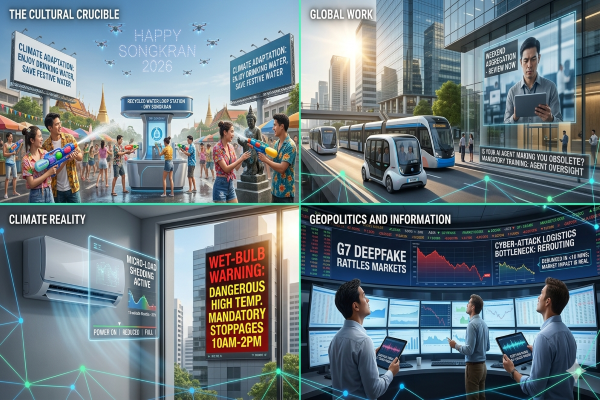
1. The Cultural Crucible: The Asian Solar New Year
While April 12 was the eve, April 13 is the dawn of one of the most significant cultural moments in Asia. In the Vedic calendar, the Sun transits into Aries (Mesha Sankranti) on this day, marking the Solar New Year.
- South & Southeast Asia in Celebration: April 13 is Pohela Boishakh (Bengali New Year), Vishu (Kerala), Baisakhi (Punjab), Songkran (Thailand), and Thingyan (Myanmar).
- The 2026 Twist: The traditional water fights of Songkran and Baisakhi will be heavily modified by the ongoing "Climate Adaptation" protocols. With water scarcity a major pre-monsoon issue in 2026, governments are urging "dry celebrations" or the use of recycled, closed-loop water systems in urban centers. Drone shows will replace traditional fireworks in major cities like Bangkok and Dhaka to reduce air pollution.
- The Festive-Work Clash: Because this New Year is tied to the solar calendar (not the Gregorian workweek), millions of diaspora and local workers face the modern dilemma of logging into a Monday morning sprint while their cultural traditions demand a festive holiday. AI scheduling assistants will be working overtime to navigate time-off requests.
2. The Global "Monday": Work in the Agent Era
April 13, 2026, is a typical Monday morning, but the nature of "work" has fundamentally shifted from just two years prior.
- The Triage Morning: As knowledge workers log on, their first task is no longer checking emails; it is reviewing the "Weekend Aggregation"—a summary compiled by their personal AI agents of everything that happened, categorizing what requires human empathy/negotiation versus what the agent already resolved.
- The Micro-Commute: With the 4-day workweek now standard in many sectors, Monday is the high-intensity "anchor day" for in-person collaboration. Urban transit systems see a surge, but rush hour is smoother than in the 2020s, thanks to dynamic, AI-routed public transit and the slow but steady rollout of Level 4 autonomous commuter pods in major megacities.
- Skill Anxiety: The Monday morning news feeds are dominated by a familiar 2020s anxiety, now evolved: “Is my AI agent making me obsolete?” Corporate training modules on "Agent Oversight and Strategic Delegation" are mandatory Monday viewing.
3. The Climate Reality: Grid Strain and Heat
Mid-April 2026 is the brutal peak of the pre-monsoon summer for the Global South. A Monday brings the full weight of commercial and industrial activity onto strained power grids.
- The 10 AM Peak: As offices, factories, and millions of AC units power up simultaneously across the Indian subcontinent and Southeast Asia, energy grids reach critical thresholds.
- Dynamic Blackouts: To prevent total grid collapse, AI-driven "micro-load shedding" is deployed. Instead of blacking out whole neighborhoods, individual smart-appliances (like EV chargers and water heaters) are remotely throttled down for 15-minute intervals. Most citizens don't even notice, but it is the only way to keep the power on.
- The Wet-Bulb Warning: Meteorological agencies are issuing severe warnings for parts of South Asia and West Africa. Humidity combined with 40°C+ temperatures is pushing the "wet-bulb" temperature to lethal levels, making outdoor physical labor a life-threatening hazard. Unions are striking for mandatory midday work stoppages.
4. Geopolitics and Markets: Pricing the Weekend
Financial markets open on Monday to price in whatever crises or breakthroughs occurred over the weekend.
- The Green Tech Race: Asian markets (Tokyo, Hong Kong, Mumbai) open strongly on Monday morning, driven by the latest breakthroughs in solid-state battery manufacturing or green hydrogen. The "Green Premium" on stocks is no longer a niche ESG trend; it is the core driver of market capitalization.
- Cyber-Vulnerabilities: Over the weekend, a likely scenario is a major ransomware attack on a supply chain (perhaps a critical minerals mine in Africa or a logistics port in Europe). Monday is spent calculating the insurance fallout and rerouting global shipping algorithms to bypass the digital/physical bottleneck.
5. The Information Ecosystem: The Deepfake Digest
On a Monday, the news cycle is hungry for attention after a weekend lull.
- The "Debunked but Damaged" Cycle: On the morning of April 13, a leaked audio clip of a major G7 leader making a controversial geopolitical threat goes viral. By 9:00 AM IST, cryptographic watermark scanners and deepfake detection algorithms confirm it is AI-generated. However, by the time the debunking reaches the top of the news feeds, the markets have already dipped, and geopolitical rivals have already issued retaliatory statements. The speed of AI generation outpaces the speed of truth.


Share on