


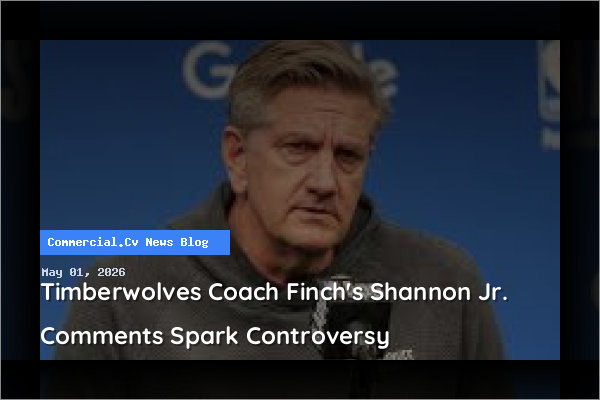
Finch's "Tone-Deaf" Remarks on Terrence Shannon Jr. Allegations Cause Stir
The professional sports world is no stranger to controversies, and the latest to capture attention involves Minnesota Timberwolves Head Coach Chris Finch and player Terrence Shannon Jr. A recent commentary from the blog "Dunking with Wolves" has highlighted Finch's remarks regarding Shannon Jr.'s ongoing legal issues, labelling them as "tone-deaf" and suggesting the coach has "missed the forest for the trees." This incident raises critical questions about how sports organizations and their leaders address sensitive off-court matters involving their athletes.
Background: The Terrence Shannon Jr. Situation
Terrence Shannon Jr., a promising player, has been embroiled in a legal battle stemming from an alleged incident. While the specifics of the allegations are sensitive and have not been fully detailed in public legal proceedings, the nature of the charges has significant implications for his career and the team. The legal process is ongoing, and it's crucial to remember that all individuals are presumed innocent until proven guilty. However, the mere existence of such allegations places a spotlight on the player and, by extension, the team he represents.
Key Developments: Finch's Controversial Quote
The core of the controversy lies in a quote attributed to Coach Chris Finch, as reported by "Dunking with Wolves." The article suggests that Finch, when discussing Shannon Jr., focused on aspects that seemed to downplay or sidestep the gravity of the underlying allegations. While the exact wording of Finch's quote isn't provided in the prompt, the criticism implies a focus on basketball-related concerns or team dynamics, rather than acknowledging the broader societal and personal implications of the legal situation. The commentary from "Dunking with Wolves" argues that this approach demonstrates a lack of awareness or sensitivity to the seriousness of the accusations, which could involve significant harm to others.
The critique posits that Finch's comments, by prioritizing immediate team needs or player performance over the ethical and legal ramifications of the allegations, miss the larger picture. This perspective suggests that a more empathetic and responsible approach would involve acknowledging the seriousness of the situation and its potential impact beyond the court. The article implies that Finch's focus on the "trees" – the immediate basketball concerns – prevents him from seeing the "forest" – the wider ethical, legal, and societal implications.
Impact and Analysis: Corporate Responsibility and Player Conduct
This incident brings to the forefront the complex relationship between sports franchises, their athletes, and public perception. In an era of heightened awareness regarding social justice and personal accountability, comments like those attributed to Finch can have a significant negative impact. For the Minnesota Timberwolves organization, this situation presents a challenge in managing public relations and demonstrating a commitment to ethical conduct.
The analysis suggests that sports figures, especially coaches and team management, are often seen as role models. Their public statements carry weight and can influence public opinion. When a coach appears to be dismissive of serious allegations against a player, it can be interpreted as a lack of seriousness about the issue itself, or worse, an endorsement of the player's actions regardless of the legal proceedings. This can alienate fans, sponsors, and the wider community, who increasingly expect organizations to take a principled stand on matters of integrity and safety.
Furthermore, the "Dunking with Wolves" commentary likely points out that such remarks can also create internal friction within the team and the organization. While players might expect support from their coach, there's a fine line between support and appearing to excuse or ignore serious accusations. A balanced approach that acknowledges the legal process, expresses concern for all parties involved, and maintains a commitment to team values is often the most prudent path.
The criticism also touches upon the broader trend of how sports organizations navigate player misconduct. Historically, there have been instances where teams have been accused of protecting players accused of wrongdoing. In today's climate, such perceived leniency is often met with swift and strong public backlash. The expectation is that teams will act responsibly, upholding both legal standards and ethical principles, even when it involves their star players.
What's Next: Navigating Future Statements and Organizational Policy
The controversy surrounding Finch's comments underscores the need for careful communication and robust internal policies for handling player misconduct and legal issues. For the Minnesota Timberwolves, this incident may prompt a review of their media training and crisis communication strategies. It is essential for leadership to understand the nuances of public statements, particularly when dealing with sensitive legal matters.
Moving forward, the organization will likely face continued scrutiny regarding its handling of the Terrence Shannon Jr. situation. Future statements from the team and its representatives will be closely watched. The hope is that subsequent communications will demonstrate a more comprehensive understanding of the issues at hand, balancing support for the player with a clear acknowledgment of the seriousness of the allegations and respect for the legal process. The focus should be on transparency, accountability, and a commitment to upholding ethical standards, ensuring that the organization is not perceived as overlooking significant off-court concerns for the sake of on-court success.
Source: Dunking with Wolves



Share on