


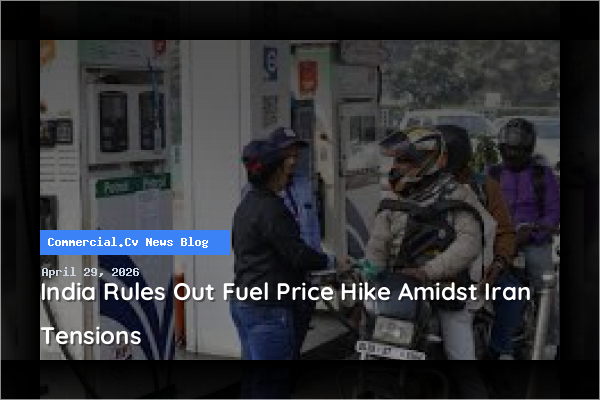
India Assures Consumers: No Immediate Fuel Price Hike Despite Global Oil Volatility
In a significant announcement aimed at reassuring the public and businesses, the Indian government has stated that there are no immediate plans to increase petrol and diesel prices, even as global oil markets grapple with disruptions stemming from the escalating tensions between Iran and Israel. The assurance comes as the ongoing geopolitical conflict in the Middle East has sent ripples of uncertainty across international energy markets, raising concerns about potential supply chain issues and subsequent price hikes in fuel-consuming nations like India.
Background: The Shadow of Geopolitical Instability on Oil Markets
The global oil market is intrinsically linked to geopolitical stability, particularly in the Middle East, which is a major hub for crude oil production and transit. Recent escalations in the conflict involving Iran, a significant oil producer, have heightened anxieties about potential disruptions to supply routes and production facilities. Such events have historically led to sharp increases in crude oil prices, directly impacting countries that are heavily reliant on oil imports, like India. India imports over 80% of its crude oil requirements, making its economy particularly vulnerable to fluctuations in global oil prices. Any significant surge in crude oil prices can translate into higher retail prices for petrol and diesel, impacting household budgets, transportation costs, and the overall inflation rate.
Key Developments: Government's Stance and Market Signals
Responding to the growing apprehension, the Centre has made it unequivocally clear that it does not intend to raise the prices of petrol and diesel at this juncture. This stance is a deliberate move to mitigate the economic burden on consumers and businesses who are already navigating a complex economic landscape. While global crude oil prices have seen some volatility due to the Iran-Israel conflict, domestic fuel prices in India have remained relatively stable in recent times. This stability is often attributed to a combination of factors, including the government's strategic management of fuel reserves, its engagement with oil-producing nations, and the existing pricing mechanisms for petrol and diesel, which are subject to regular reviews and adjustments based on international benchmarks.
Sources within the government have indicated that the decision to maintain current fuel prices is a proactive measure to support economic growth and control inflation. The government is closely monitoring the global situation and is prepared to take necessary steps to ensure the availability of fuel and maintain price stability. This includes exploring all available options to buffer the domestic market from external shocks. The Ministry of Petroleum and Natural Gas is reportedly in constant dialogue with oil marketing companies and international energy agencies to gather real-time information and assess the evolving market dynamics.
Impact and Analysis: Economic Repercussions and Consumer Relief
The government's decision to hold steady on fuel prices is a welcome relief for millions of Indian consumers and a wide array of industries. A hike in petrol and diesel prices would have inevitably led to an increase in transportation costs, impacting everything from daily commutes to the prices of essential goods and services. For businesses, particularly those in logistics, transportation, and manufacturing, stable fuel prices are crucial for maintaining operational efficiency and profitability. This assurance can help in curbing inflationary pressures that could otherwise be exacerbated by rising energy costs.
Economists suggest that the government's commitment to price stability in the face of global uncertainties reflects a pragmatic approach to economic management. While the global oil market remains a volatile factor, the domestic pricing strategy can play a significant role in insulating the Indian economy from the worst of these shocks. The government's ability to manage this situation effectively will be a key determinant in its broader efforts to control inflation and foster sustainable economic growth. The current stability also signals the government's priority in ensuring that the common citizen is not unduly burdened by external economic adversities.
What's Next: Monitoring Global Trends and Domestic Preparedness
While the immediate outlook for fuel prices in India appears stable, the situation remains dynamic. The trajectory of the Iran-Israel conflict and its impact on global oil production and supply chains will continue to be closely monitored. The Indian government is expected to maintain its vigilant approach, engaging in continuous dialogue with international partners and oil producers. Furthermore, the government may also explore long-term strategies to enhance India's energy security, potentially through diversification of energy sources, increased domestic exploration, and greater adoption of renewable energy technologies. For now, consumers can breathe a sigh of relief, with the assurance that their daily fuel expenses will not be immediately impacted by the geopolitical turmoil in the Middle East.
Source: NDTV



Share on